

Tariffs and disruption complicate aftermarket supply chain decisions
Share

View the latest digital editions of all of our publications or head straight to the archives

Share
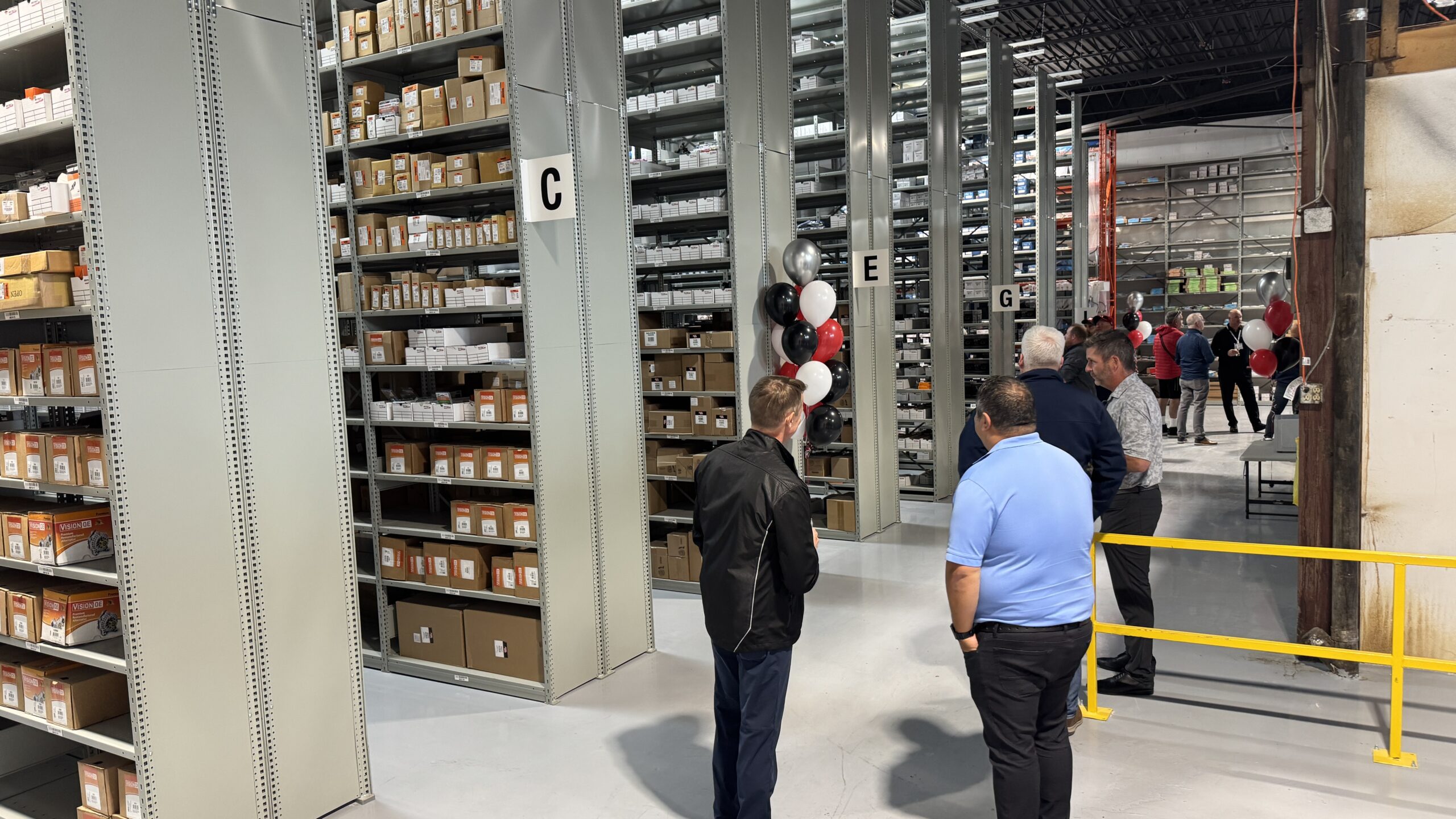
With ongoing disruption in today’s supply chain, jobbers and distributors face a lingering issue when it comes to deciding how much inventory to carry to maintain customer supply.
While slowdowns in production do little to temper repair demand, changes in manufacturing, sourcing and transportation can complicate how parts are replenished, and distributors must find a balance between availability and costs.
“The aftermarket often experiences disruption differently than vehicle production because service demand continues regardless of what’s happening upstream,” says Fab Brasca, senior vice-president of market strategy and supply chain expert with Kinaxis. “The challenge for distributors is maintaining service levels while managing more uncertainty around inventory placement, replenishment timing and transportation costs.”
Statistics Canada data reveal a significant drop in exports of motor vehicles and parts from Canada. Over a 17-month span from March 2025 to July 2026, exports fell from $104.4 billion to $91.4 billion, a 13 per cent drop. U.S. Census data show an even steeper decline in the value of U.S. vehicle and parts imports from Canada, which dropped more than 34 per cent from US$5.266 billion to US$3.461 billion over the same period.
But Alan Arcand, chief economist with Canadian Manufacturers & Exporters (CM&E), cautions against attributing this decline to any single factor.
“That comparison does not isolate the effect of tariffs alone, since trade values are also influenced by vehicle model cycles, production interruptions, consumer demand, exchange rates and supply-chain conditions,” he says. “However, tariffs and ongoing uncertainty have added to business risk and made production and investment decisions more difficult.”
Indirect costs
Beyond paying the actual tariff on any particular vehicle or part, there are several indirect costs affecting the automotive aftermarket and supply chain sectors.
These include customs brokerage and trade advice, classification and origin documentation, inventory carrying costs, contract negotiation, shipping changes and border delays, along with the administrative burden these create for smaller independent businesses. The impact of tariffs is far-reaching, and the added costs must either be absorbed or passed on to customers.
“These indirect costs are especially hard on SMEs because they often do not have in-house trade compliance teams and have less working capital to absorb disruptions.”
– Alan Arcand, chief economist with Canadian Manufacturers & Exporters
He points to CM&E’s broader manufacturing survey, which found that among affected companies, 55 per cent were absorbing tariff costs or reducing their margins. Forty-eight per cent were raising prices for U.S. customers.
“We do not have an automotive-specific estimate of how tariff costs are being split between manufacturers and customers,” he says.
Arcand says this broad impact of tariffs is being felt across the automotive and supply chain sectors, highlighting that recent data suggest motor vehicle body and trailer manufacturing has seen a large decline, down 8.9 per cent since January 2025. On the other hand, vehicle parts manufacturing is up five per cent over the same period.
“That suggests parts producers, in aggregate, have been more resilient than some other auto-related segments over this period, although individual firms may still be under significant pressure from tariffs, compliance costs and uncertainty,” he says.
Planning is essential
Establishing a plan and considering alternatives become a necessity during times of uncertainty. Kinaxis says its North American customers have been running around 25 per cent more scenarios over the past month than they were at the beginning of the year.
And, as Brasca points out, the increase is not limited to one industry.
“Automotive scenario activity increased 11 per cent, consumer products increased 14 per cent, high tech increased 69 per cent and oil and gas increased 177 per cent, suggesting organizations across sectors are evaluating more options as uncertainty rises,” he says. “We’re seeing companies evaluate more alternatives, but it’s important not to confuse planning activity with actual operational moves.”
On the automotive side, Brasca says the increased scenario planning focuses mainly on sourcing alternatives, supplier exposure, production allocation, inventory positioning, transportation routes and customer commitments.
“Canadian automotive companies are closely watching how changing trade conditions could affect where they source parts, how they manage inventory and how they keep production running,” says Brasca. “What this tells us is that companies are spending more time evaluating options before making decisions. They’re looking to understand the operational and financial impact of different choices before they need to act.”
Trading one problem for another
One thing companies want to avoid is making an operational change to avoid one issue only to create another.
As Brasca explains, the most advanced organizations no longer evaluate a single risk in isolation, as disruptions seldom occur one at a time.
“A sourcing change that reduces tariff exposure may increase transportation complexity, supplier concentration risk or dependence on another region. Companies are looking at those risks together instead of treating them as separate issues,” he says. “They want to understand how sourcing, inventory and logistics decisions perform across different situations, not just under today’s assumptions.”
Brasca says any decision needs to make sense even if the trade situation between Canada and the U.S. changes, transportation is disrupted or demand unexpectedly changes.
“As a result, the conversation is becoming less about finding the lowest-cost option and more about finding the most resilient one,” he says.
Arcand says that although companies are examining alternative sourcing and production options to reduce tariff costs, the process is neither quick nor simple, particularly in the automotive industry.
“In automotive manufacturing, supplier relationships, certification requirements, logistics and customer delivery schedules are tightly integrated across North America,” he says. “That means smaller suppliers, especially those heavily tied to U.S. customers, often have limited room to diversify in the short term.”
Both Brasca and Arcand acknowledge the difficulty and hesitation many organizations can experience when making operational decisions in the face of disruption.
“Most organizations are trying to avoid making permanent decisions based on what may ultimately prove to be temporary conditions,” says Brasca, adding that companies must evaluate whether the benefits of a long-term change outweigh the cost and disruption of making it.
“Companies are weighing the expense of moving production, onboarding new suppliers, adding warehouse capacity or changing logistics networks against the possibility that trade conditions could shift again,” he says. “The companies moving forward most confidently are the ones that have a clear view of the cost, risk and customer impact before they invest. The focus isn’t on predicting what comes next. It’s on understanding which options make sense across a range of possible outcomes.”

Arcand says that when organizations hesitate to make a change, it can lead to delayed investment, more cautious sourcing decisions and a reluctance to commit to long-term expansion plans.
He also says manufacturers are telling CM&E that tariff threats and policy uncertainty are causing them to pause or defer decisions on machinery, tooling, production lines and hiring.
“Investment data point in the same direction: manufacturing construction spending in Canada is down 17 per cent since January 2025, and spending in the U.S. has fallen even more,” says Arcand. “While a number of factors can influence construction activity, the broader picture is clear — uncertainty is discouraging investment on both sides of the border. That is especially concerning in automotive and related supply chains, where projects are capital-intensive and depend on predictable access to the U.S. market.”
Factors outside tariffs
While relief from the added costs related to tariffs would be welcome, there are other factors affecting the automotive and supply chain sectors.
As Arcand explains, compliance with the Canada-United States-Mexico Agreement (CUSMA) is essential, but it doesn’t shield manufacturers if a new tariff measure is applied to goods that would otherwise qualify under the agreement.
“Duty drawback and remission can provide meaningful relief in some cases, but firms tell us these processes can be documentation-heavy, slow and difficult to navigate, especially for SMEs,” he says, adding that “drawback” often means paying the duty up front only to be reimbursed later. “The key issue is not whether relief exists on paper, but whether it is fast, practical and predictable enough to help companies before production, employment or investment decisions are affected.”
Brasca says even if tariffs were lifted tomorrow, most organizations would continue to value the flexibility they developed.
“Supply chain leaders are also navigating transportation disruptions, supplier constraints, shifting demand patterns and geopolitical developments,” he says. “The broader trend is a growing emphasis on flexibility. Companies want supply chains that can adapt as the environment evolves, rather than being optimized for a single set of assumptions.”
Recommendations
Brasca says smaller companies should prioritize understanding where they are most exposed to disruption.
“That usually means identifying the suppliers, products or transportation routes that would have the greatest impact on customer service if disrupted,” he says.
Organizations should also avoid falling into the trap of redesigning their entire network and instead focus on the handful of decisions that create the greatest operational risk. The cost of any major investment and the time it takes to implement it are other important factors to consider.
“One lesson we’ve consistently seen is that flexibility often creates more value than optimizing around a single forecast,” says Brasca. “The companies that adapt best tend to be the ones that can evaluate their options quickly and act with confidence.”
As for what recommendations Arcand would have for governments renegotiating CUSMA to help automotive manufacturers and exporters, he says tariff-free trade, a full 16-year extension and faster action on the things Canada can control are all essential.
“Especially tax and regulatory reform,” he says, “to reduce investment delays, improve competitiveness and make Canada a stronger place to build, expand and modernize manufacturing operations.”
Canada and the United States continue to impose or retain tariffs that could raise costs for automakers, parts suppliers and aftermarket businesses in both countries.
Effective Sept. 8, Canada introduced matching counter-tariffs of 15, 25 or 50 per cent on US$27.6 billion in American goods. Automotive-related duties include 50 per cent on targeted U.S. steel and aluminum and 25 per cent on specified tools, plastics and electronics used in vehicle manufacturing, repair equipment and replacement parts. Canadian businesses lacking domestic or non-U.S. alternatives may seek exceptional tariff relief.
Canada’s existing 25 per cent tariff remains on U.S. vehicle imports that do not comply with the Canada-U.S.-Mexico Agreement (CUSMA). Compliant U.S. vehicles face that rate only on content originating outside Canada and Mexico. Canada also retains 25 per cent duties on selected U.S. automotive goods: windshields and other vehicle glass, retreaded passenger and commercial-vehicle tires, used vehicle tires and specified motorcycles.
The U.S., meanwhile, has imposed a 50 per cent Section 338 tariff on specified Canadian goods over alleged discriminatory treatment of U.S. motor vehicles. Goods already subject to Section 232 tariffs—automobiles, designated automotive parts, steel and aluminum—are excluded, preventing overlapping charges.
Canadian-built vehicles entering the U.S. still face a separate 25 per cent automotive tariff, applied only to non-U.S. content for CUSMA-qualified vehicles. Designated engines, engine parts, transmissions, powertrain and electrical components fall under U.S. automotive-parts tariffs. CUSMA-qualified parts remain exempt pending a system to tax their non-U.S. content.
U.S. Section 232 duties on Canadian steel and aluminum generally stand at 50 per cent for covered primary metals, 25 per cent for many derivatives and 15 per cent for certain industrial machinery and power equipment. Special provisions for qualifying Canadian goods include a 25 per cent duty on non-U.S. content, with a minimum effective rate of 15 per cent, for certain products under the June 2026 adjustment.
Canadian assemblers and repair businesses may consequently pay more for American metals, equipment and components, while U.S. manufacturers importing Canadian vehicles, metals or parts face higher input costs. With automotive components often crossing the border repeatedly during production, even raw-material tariffs can compound across the supply chain.
Leave a Reply