



After short and extended trips with a RAV4 Hybrid, here’s who it’s best for, and where to think twice
Toyota’s RAV4 Hybrid is one of the best-selling vehicles in Canada. It promises lower fuel costs, a quieter ride at low speeds, and all the practicality of a mid-size SUV.
But how does it actually perform when you’re driving it every day? A week of real-world trip data tells an interesting story.
Hybrids ended 2025 as the fastest-growing powertrain segment in Canada, with combined hybrid share rising to a record 17.2 per cent of the market — up from 13.3 per cent the year before, according to S&P Global Mobility. In Ontario alone, hybrids reached 19.7 per cent market share, more than double the province’s zero-emission vehicle share. So Auto Service World went out to do some real-world research.
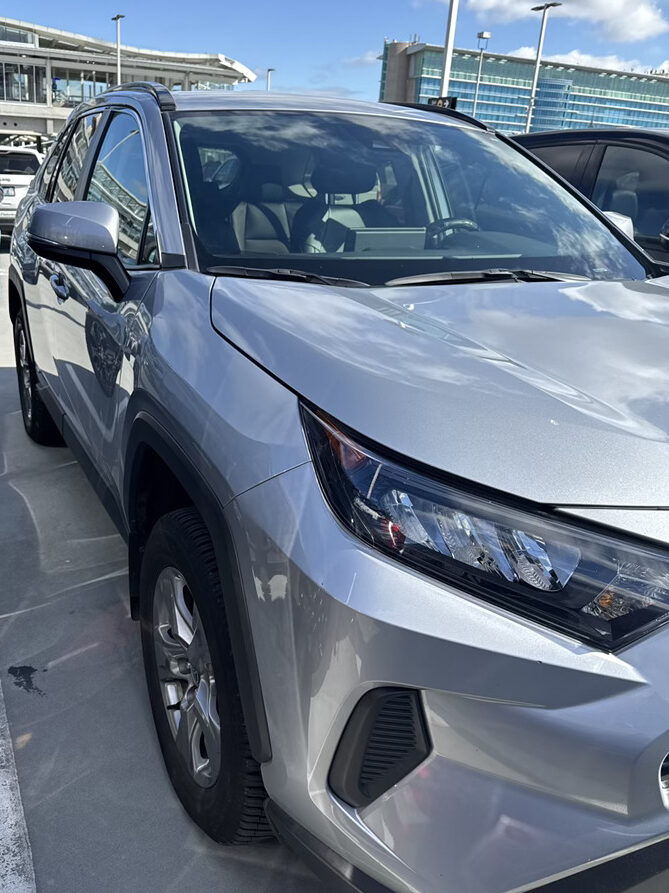
Two RAV4 Hybrids were used over the course of seven days and under varying conditions. Both were rented through Turo, which allows users to rent a vehicle owned by a third party. Done through the app, the vehicle’s owner can deliver the vehicle to the renter, which is what was done in both cases. The first was in Vancouver, where the vehicle was picked up with clear instructions from the host about where to pick up and drop off at Vancouver International Airport. The second use of Turo a few days later was for a road trip from Toronto to a conference in Detroit. In this case, the host dropped the vehicle off to my house and picked it up from the same location.
While the Vancouver trip was mostly city and suburban driving, the Detroit trip was a long, consistent journey. The RAV4 Hybrid delivered fuel economy figures ranging from 5.2 to 7.1 L/100km. That’s a wide spread. But the reason for it is the same every time: How much work the electric motor was allowed to do.
Where it shines
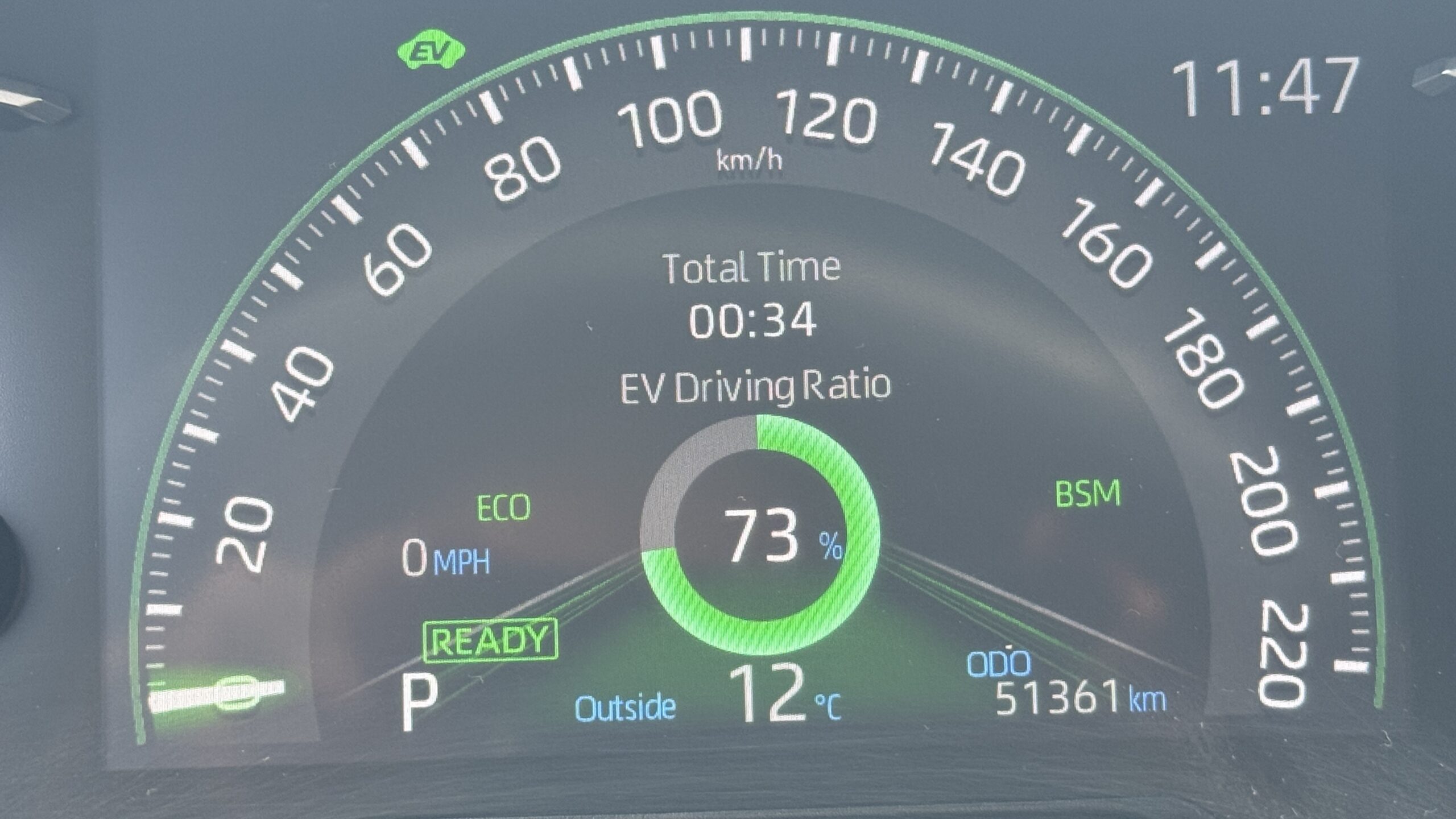
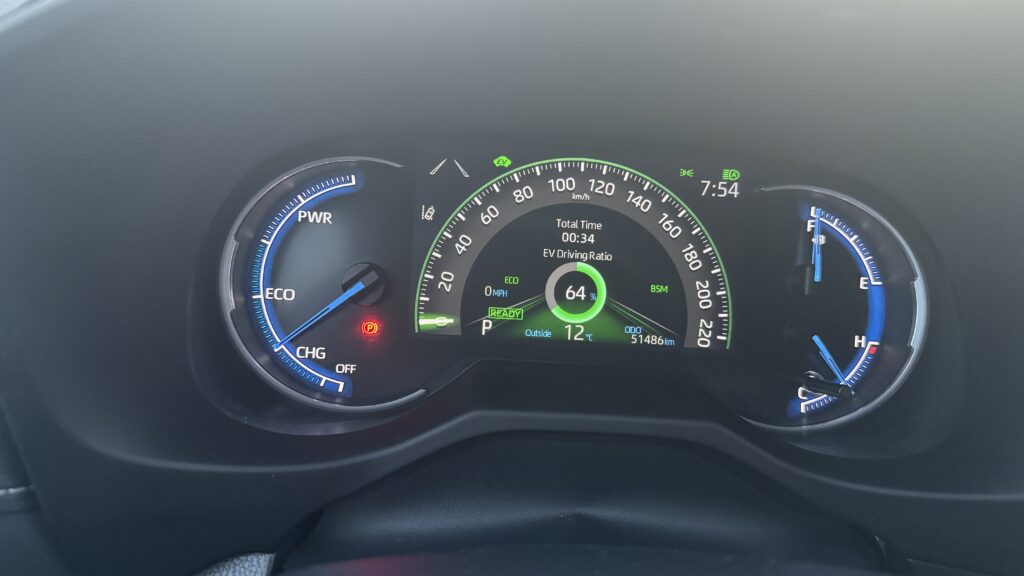
In the city and suburbs, the RAV4 Hybrid is impressive. On a 33-kilometre mixed suburban run, it returned 5.2 L/100km with a 63 per cent EV driving ratio — meaning the gas engine sat idle for nearly two-thirds of the trip. Another short urban errand pushed the EV ratio even higher, to 73 per cent.
This is the appeal of the hybrid option. Stop-and-go driving is where hybrid systems earn their value. Every time you brake, the electric motor acts as a generator, putting energy back into the battery. Every time you pull away slowly from a light, that stored energy powers the wheels instead of burning fuel. The physics work in the driver’s favour at low speeds.
Where it struggles
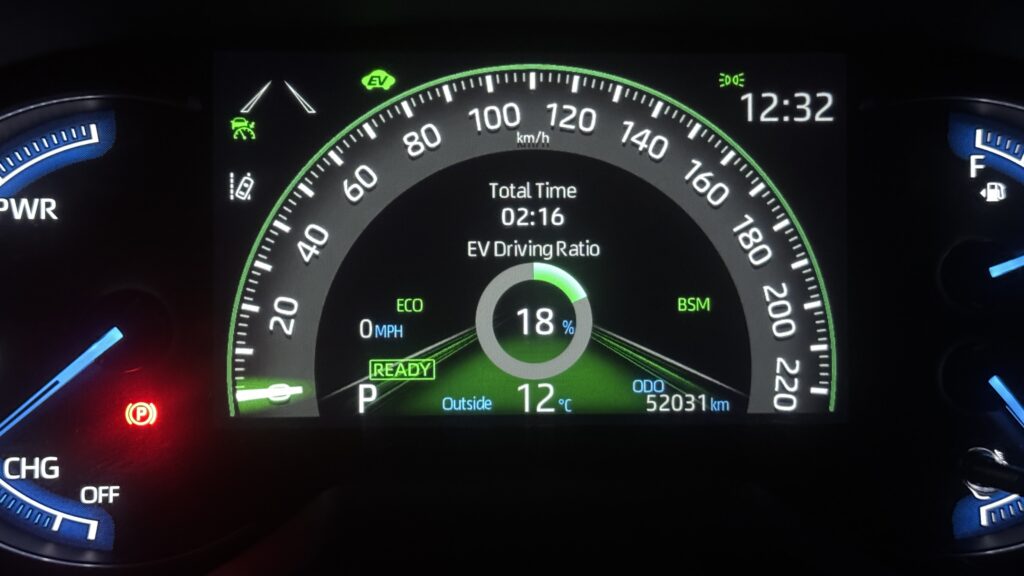
The longer highway trips told a very different story. Over 214 kms at sustained speed, the EV driving ratio dropped to just 18 per cent and fuel economy came in at 6.5 L/100km. That’s still decent for a mid-size SUV, but it’s nowhere near the numbers the car can post in the city.
At highway speeds, there’s little opportunity for the battery to recharge. There’s no coasting, no braking, no low-speed crawl through traffic. The electric motor can’t sustain the load at 100 km/h, so the gas engine does the heavy lifting and the hybrid system becomes a passenger for the most part.
A shorter but faster run of 27.5 kilometres showed a similar pattern — 33 per cent EV ratio and 5.7 L/100km. Whenever speeds stayed consistently high, the electric advantage faded.
The results
The RAV4 Hybrid does what it’s designed to do — it’s just important to understand what that design is optimized for. It’s not a fuel-sipper on every road but in specific conditions where the electric motor can contribute meaningfully.
As countless experts have recommended, drivers should honestly assess their typical weekly driving before considering the type of powertrain they want to buy. If most of your kilometres come from city commutes, school runs and suburban errands, a hybrid like the RAV4 makes strong financial and practical sense. If you’re regularly covering long highway distances — say, commuting between cities, making regular trips to the cottage, or covering rural routes — the economics become much harder to justify against a well-tuned conventional engine.








Leave a Reply