

The thermostat housing is an assembly now, and that changes the comeback math
Share

View the latest digital editions of all of our publications or head straight to the archives

Share
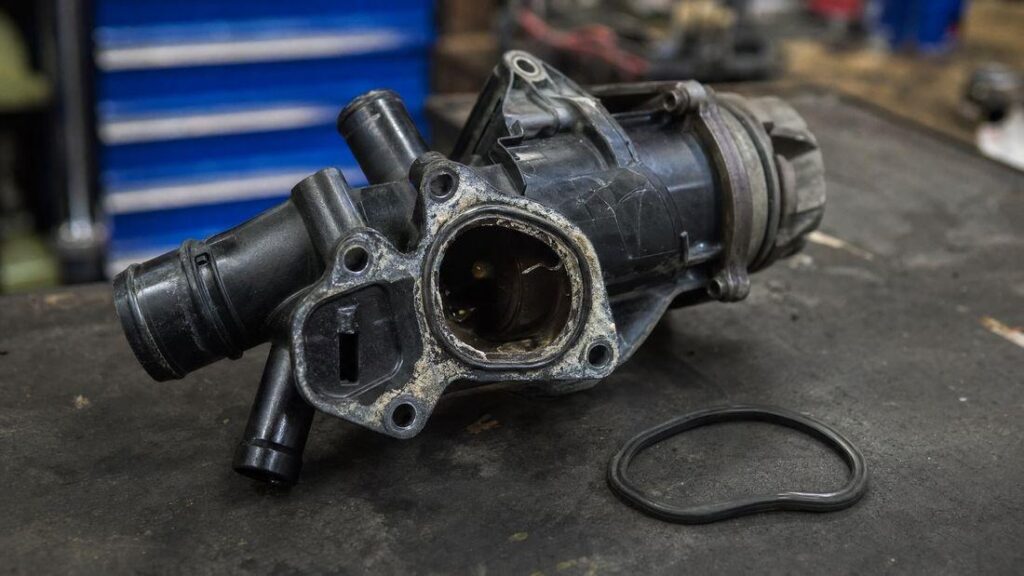
The sealing face is the part you cannot judge by eye, and the part that decides whether the job comes back.
Every shop has had this ticket. Customer complains of a slow coolant loss with no visible drip on the driveway. You pressure test, find weeping at the thermostat, order a thermostat and a gasket, fit it, and the vehicle comes back in six weeks with the same complaint. The second time you look properly at the housing and find the sealing face is no longer flat.
That sequence is not a diagnostic failure. It is a parts-supply assumption that stopped being true somewhere around 2010.
The old arrangement was simple: an aluminum housing bolted to the block, a wax-pellet thermostat sitting in a machined recess, a paper or rubber gasket between them. Everything was serviceable individually, and the housing outlived several thermostats.
The current arrangement puts the thermostat, the housing, the coolant temperature sensor and frequently the water pump itself into a single moulded assembly. Glass-filled polyamide replaces the aluminum. Weight comes down, cost comes down, and packaging gets tighter because the whole unit can be shaped around whatever space is left in the engine bay.
The trade-off is that plastic ages differently from aluminum. It does not corrode. It embrittles, and it takes a permanent set at the clamped face after enough heat cycles. By the time it leaks, the failure is dimensional and no amount of sealant will bring it back.
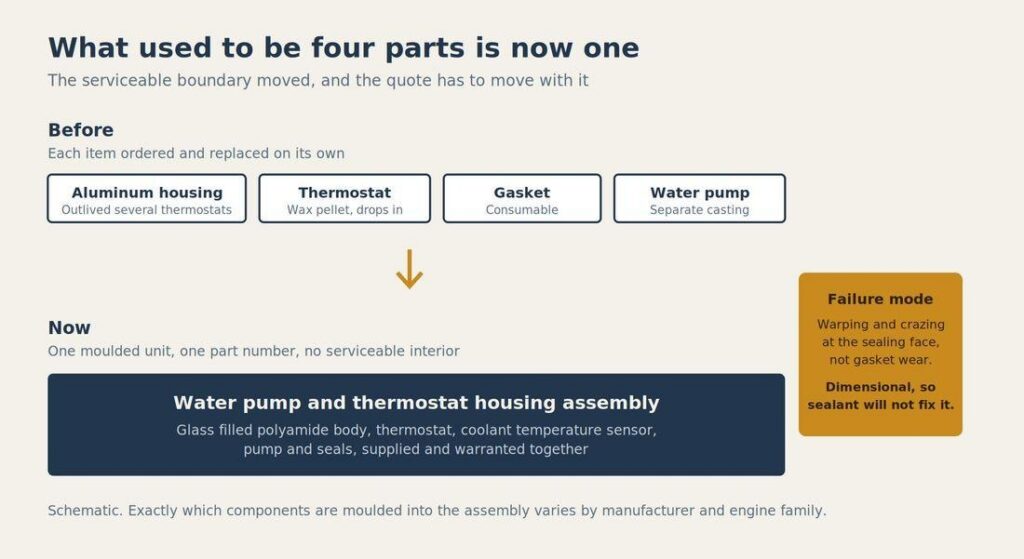
The parts count did not go up. The smallest thing you are allowed to order did.
The sealing face on a warped housing is the part you cannot inspect properly on the bench.
| What you see | What is actually happening | What it costs to get wrong |
|---|---|---|
| Weeping at the thermostat joint | Housing face is no longer flat | Same complaint back in weeks |
| Crazing around the bolt bosses | Plastic has embrittled under clamp load | Housing cracks on reassembly torque |
| Stained coolant, brown residue | Contaminated or intermixed coolant | Attacks the seal and the new part too |
| Sensor reading erratic | Sensor moulded into a distorted housing | Diagnostic time billed twice |
| Pump weep hole dry, coolant still low | Leak is at the housing, not the pump | Pump replaced, complaint unchanged |
Notice the last row. On assemblies where the pump and housing share a casting, a housing leak reads on a quick inspection as a pump problem, and the technician who condemns the pump alone is right about the assembly and wrong about the cause.
The parts side is straightforward once you accept the unit. A Water Pump and Thermostat Housing Assembly for a common Audi, Volkswagen, BMW or Ford application sits somewhere between AUD 99.99 and 499.99 depending on how much of the cooling circuit the manufacturer chose to mould into it, and the aftermarket catalogue depth is now genuine: 323 variants across those makes in one Australian listing alone, with BMW, Audi and Volkswagen accounting for most of them.
Labour has not moved much. What has moved is the conversation with the customer, because a plastic assembly priced like a small casting invites the question of whether the cheap thermostat will do. The honest answer is that on these engines there is no cheap thermostat, because it is not sold separately.
Three things worth building into the quote:
The material spec matters more on plastic than it did on aluminum, because the housing is in contact with the fluid and is doing structural work at the same time.
Glycol base engine coolant for automobile and light-duty service is covered by ASTM D3306, which sets the requirements for freeze, boil and corrosion protection at dilutions between 40 and 70 percent by volume. That specification is what the seal materials and the polyamide were validated against. Intermixing incompatible coolants, or running a dilution outside that band, changes the fluid the housing sits in for the rest of its life.
This is the part customers argue about and the part that decides whether the job is profitable. A five dollar saving on coolant is not a saving when the assembly comes back.
Before quoting a housing on any vehicle, run the VIN. Cooling system components turn up in recall and defect campaigns often enough to be worth thirty seconds, and Transport Canada’s defects and recalls service will search by VIN directly. A campaign repair is a different conversation from a customer-pay job, and finding out afterwards is the worst version of it.
The broader shift is not really about thermostats. It is that manufacturers keep consolidating serviceable parts into assemblies, and the shops that adjust their quoting language early stop having the same argument every time one of them fails.




Leave a Reply