

Cooling by Colour
Share

View the latest digital editions of all of our publications or head straight to the archives

Share
You could be forgiven for thinking that all coolants are created equal. They all pull engine heat into the rad, are designed to prevent corrosion, and follow the same path under the hood. It’s the array of available colors that should be your first indication that something is different indeed. Ford has its yellow, GM has orange, BMW offers blue, and there are still jugs of traditional green antifreeze somewhere in the mix. And if you reach for the wrong formula, you could be asking for trouble. Ford, for example, has gone so far as to add “no orange” stickers to expansion bottles to ensure that Organic Acid Technology (OAT) formulas don’t mix with the HOAT (Hybrid Organic Acid Technology) that it prefers. It’s the HOAT that protects aluminum components from cavitation-related corrosion that can eat away at pump impellors, backing plates, aluminum cylinder heads, and the solder used in copper and brass radiators. But warnings that focus on specific coolant formulas are not limited to the times that you conduct a complete flush and fill.
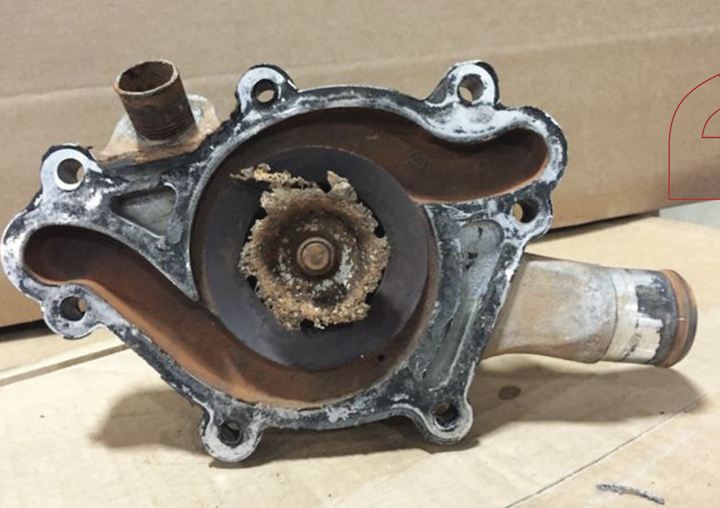
Any mixture of different coolants can counteract the integrity of rust inhibitors, explains Joe Bolyard, manager of ASC Industries’ product support group, which supplies water pumps. The result is scale and sediment that builds up in passageways and the radiator. “You get little particles that break loose from the castings and metal surfaces and hoses.” The problem is compounded in vehicles that incorporate aluminum radiator components, he adds.
Meanwhile, traditional green coolants rely on inhibitor packages with silicates, phosphates and nitrates to prevent corrosion, but will tend to deplete more quickly than the carboxylates in Organic Acid Technology such as GM’s DexCool that first emerged in the mid-1990s. At best, a top-up with the green coolant will limit long-life attributes.
“If a shop tops up a long-life or extended-life filled tank with an extended life coolant, they will continue to maintain an extended life change interval. That is to say that they should change out the antifreeze every five years or 240,000 to 250,000 km,” says Megan Currie of Honeywell, which markets Prestone. “Should [the] shop top up a long-life or extended-life coolant with a silicate formula, the formula drops to the lowest protection, which would be the silicate [life] of 60,000 km or two years.”
Once different coolants are mixed, anti-freeze inhibitors will begin to create more calcium, adds Chuck Minz, quality assurance engineer with Fenwick Automotive. “It’s basically sludge, and that gets caught into the seal and cracks it, and you have a leaking [water] pump. That seal keeps the water from being bypassed and pushed up through the casting. It’s a frictionless environment. The ceramic is hard enough to hold the high temperature, and malleable enough not to let water by.”
“It [the seal] is basically two facing materials that rotate together. When those particles and sediment get in there, it’s the equivalent of sand in a bearing,” Bolyard explains. Compounding matters is the fact that once sediment and scale forms in the system, it also needs to be cleaned out to prevent further damage. “It’s very hard to flush that out,” Bolyard offers, noting that systems filled with a mixture of coolants will need to be back-flushed. “Generally, what happens with a flat-rate mechanic, is that they don’t want to take the time to do it.”
Even top-ups with the proper type of coolant can lead to issues if they are not mixed with the correct proportion of de-ionized or de-mineralized water. (You usually need to add a 50/50 mix.) Straight coolant will increase the acidity within the cooling system with dire consequences, Bolyard says. “It will actually eat the water pump’s impeller off in weeks.” The resulting acidic liquid, coupled with different types of metal in the system, create nothing less than a battery that can accelerate corrosion. At most, a mixture of 40 per cent de-mineralized water and 60 per cent antifreeze may be appropriate for extremely cold areas like the Prairies, Currie says. But there are even problems associated with topping up with straight water.
“The water is so corrosive in the system, and it doesn’t have any lubrication properties, which is what the seal in the water pump needs,” Bolyard adds.
Even the type of water can make a difference, since the tap water in your shop can introduce deposits that can clog passageways, while soft water contains the sodium chloride that can increase the potential for electrolytic corrosion. Pre-mixed solutions — while they aren’t cost-effective for complete flush and fills — may be the best choices for minor top-ups when you’re dealing with evaporation issues. And, of course, remember that every coolant has a life. Without adhering to schedules for flush and fills, you’re threatening the lubricating properties that would otherwise protect the thermostat. The engine will be also subjected to corrosion that will be trapped by the seal in the water pump, Minz says. “It’s like the narrowing of the arteries.”
Still, that’s not to suggest that a shop needs to stock a complete rainbow of colors. Dr. Dave Turcotte, technical director for Valvoline’s Zerex brand, suggests most shops could stock two types of coolants if they’re used with some thought. Look for an OAT formula for GMs, Asian models, and most European makes, and a HOAT for Ford, Chrysler and Mercedes, he says. Peak and Prestone, meanwhile, also offer extended life formulas that can be used in top-ups without affecting the life of an existing coolant. It’s simply a matter of giving some thought to the contents before you reach for a specific jug.






Leave a Reply