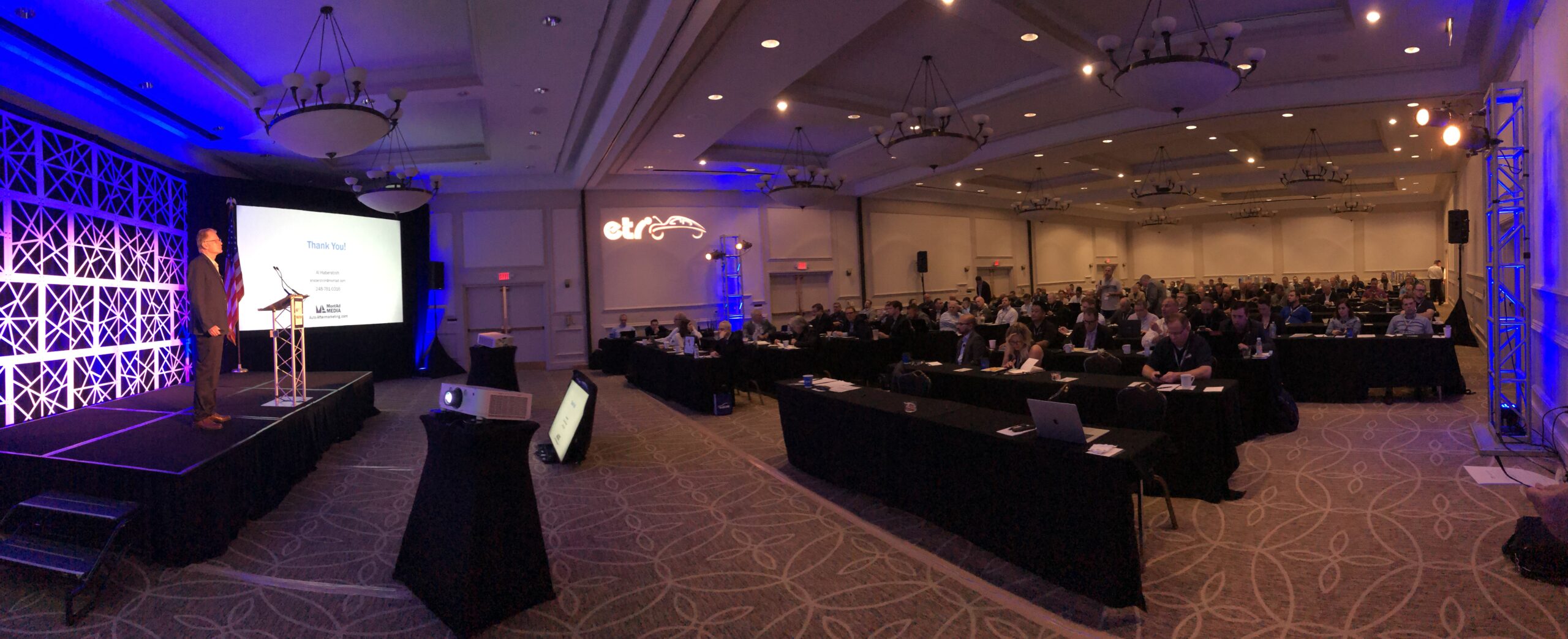
There was a record turnout at the annual Tool Tech conference in Charlotte, N.C. this year, with a wide spectrum of automotive tool and equipment companies in attendance.
The increasing complexity of advanced driver assist systems (ADAS) and the importance of following proper calibration processes in the service bay took center stage at the Equipment and Tool Institute’s annual Tool Tech conference.
ETI’s new executive director Brian Plott makes an announcement at the association’s exposition and networking event.
Held in Charlotte, N.C., at the end of April, it drew a record number of attendees, representing a wide spectrum of the industry, from original equipment manufacturers, to tool and equipment developers, to mechanical and collision repair specialists.
Tool Tech 2019 was the first ETI event managed by the associations’ new executive director Brian Plott.
A former employee of Bear Automotive Equipment, ITW, Snap-on, and Bosch, Plott has long been involved with ETI over the span of his career. He told Tool Tech attendees that the speed of technological change is posing a challenge to both tool makers and tool users.
“I am honour to work with each and every one of you at a time when some serious things are happening in the industry,” he said. “Look around you. The talented people who direct how the industry goes are all sitting here. There are some serious things we’ll have to address. We’re all going to have to work together.”
Jim Fish welcomed delegates to the 2019 Tool Tech conference in Charlotte, N.C.
Outgoing president Jim Fish said ETI had completed “a year of listening,” as it developed a new mandate, mission statement, and list of priorities.-
“We’re not done listening,” he said. “We’re here to provide value for the membership at a time when vehicle complexity is exploding, and there is growing concern over the safety and security of vehicle repair. The people in this room are on the front lines of that battle every single day.”
He said ETI is dedicated to providing a networking environment that is focused on collaboration with OEMs, and responsive to the needs of the aftermarket.
“We are the technical advisors to the industry,” he said.
Those sentiments were echoed by the incoming president, Kevin Fitzpatrick of Autologic. A former technician and a current shop owner, Fitzpatrick said ETI is dedicated to streamlining the repair process, keeping up with transportation technology, and ensuring the viability of the aftermarket.
“It’s a big industry and we’re all doing our best that we can for the technicians out there,” he said. “That’s what drives us, to make their lives a little easier, and make their bottom lines a little bit stronger.”
Chris Gardner, senior vice president of operations at the Automotive Aftermarket Suppliers Association (AASA) spoke of the most pressing aftermarket issues.Kevin Fitzpatrick accepts the ceremonial gavel as he begins his term as ETI president.Kumar Saha, of Frost & Sullivan said the future of vehicle repair and service will not be reactive, it will be predictive, proactive, and driven by software updates.Al Haberstroh, partner and chief strategy officer at MontAd Media offers his views on effective marketing for tool manufacturers.
Representatives from Toyota, Nissan, Honda, Hino, Volkswagen, and General Motors addressed the latest challenges in Advanced Driver Assist Systems at the annual Tool Tech conference held by the Equipment and Tool Institute in North Carolina.NHRA Nitro Funny Car driver Cruz Pedregon was a guest speaker at the annual Tool Tech conference held by the Tool & Equipment Institute. After a quick description of the challenges of his job, he invited the audience to join him in the parking lot to see the only operational display car… and hear what it sounds like when it’s just idling.








Leave a Reply