


Diesel Truck CCV System Maintenance: The Overlooked Service Item That’s Costing Your Customers Real Money
Share

View the latest digital editions of all of our publications or head straight to the archives

Share
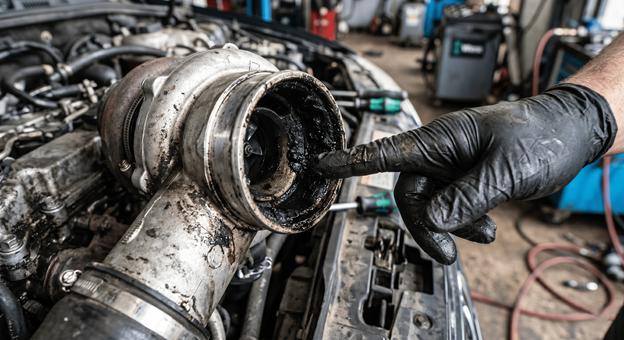
If you’ve been wrenching on diesel trucks long enough, you already know the usual suspects: clogged DPF, failing EGR cooler, a DEF system throwing fault codes at the worst possible time. But there’s another system that flies completely under the radar until it becomes a much bigger problem, and by that point, it’s already damaged components your customer didn’t budget for.
The Closed Crankcase Ventilation (CCV) system on diesel trucks like the 6.7L Ford Powerstroke, 6.7L Ram Cummins, and 6.6L GM Duramax is one of the most neglected service items in the aftermarket. It doesn’t trigger a dramatic check engine light. It won’t leave your customer stranded on I-40. What it does is quietly push oil-saturated blow-by vapor through the intake tract, fouling the turbo inlet, intercooler piping, and charge air system over tens of thousands of miles.
By the time the customer notices, the repair ticket looks a lot more painful than it needed to be.
Every diesel engine produces blow-by, combustion gases that slip past the piston rings into the crankcase. On a gas engine, a simple PCV valve handles this. On a heavy-duty diesel, you’re dealing with a far dirtier mixture of soot, unburned fuel, and thick oil mist under higher crankcase pressures.
The factory CCV system uses a coalescing filter to separate liquid oil from the blow-by gases. The oil drains back to the pan; the “cleaned” gases get rerouted into the turbo inlet to be burned off. It’s a closed-loop design, which is exactly why it’s prone to issues.
The core problem: As the filter loads up with oil residue and soot, crankcase pressure builds. When pressure exceeds the system’s capacity, oil vapor bypasses the separator and goes straight into the intake. The result is a coating of oily film across the intake manifold, intercooler core, throttle body, and turbo compressor wheel. This is exactly the kind of contamination that accelerates wear and degrades performance.
Train your service writers to ask about these symptoms on every diesel work order:
The catch? Many customers describe these as separate, unrelated problems. The oily intake boot gets cleaned and reinstalled. The oil consumption gets attributed to mileage. The turbo gets quoted for replacement. Meanwhile, the CCV system that caused all three issues never gets touched.
For trucks in good shape with reasonable mileage, CCV filter replacement is a straightforward maintenance item. On the 6.7L Cummins, most technicians recommend inspecting the filter every 15,000–20,000 miles under heavy-use conditions. Replacement is inexpensive, and catching a saturated filter early keeps the rest of the system clean.
But here’s where the conversation often shifts, especially on higher-mileage trucks or trucks that have already developed intake contamination: the factory closed-loop design is inherently limited. You can replace the filter, but the system will keep rerouting oil-contaminated vapor back through the intake by design.
That’s why a growing number of diesel owners are moving toward a CCV reroute kit as the long-term fix rather than a recurring filter replacement cycle.
A reroute kit eliminates the factory closed-loop path. Instead of recirculating blow-by back into the intake, the system vents crankcase gases safely away from the intake tract, typically through a filtered external vent. The result is a cleaner intake system over time, reduced oil contamination in the turbo and intercooler, and no more clogged filter intervals to manage.
For shops, it’s also a better upsell: one installation, no repeat filter replacement revenue, but a cleaner truck and a happier customer who stops coming back with mystery oily intake issues.
EngineGo stocks application-specific CCV reroute kits for 6.7L Powerstroke trucks, along with Cummins CCV reroute kits for Ram 2500/3500 applications and Duramax CCV reroute kits covering LLY, LBZ, and LMM engine generations. Each kit is designed to drop in with bolt-on fitment, making shop installation straightforward.
CCV maintenance isn’t a glamorous service category, but it’s one that pays dividends in customer trust. A technician who flags a saturated CCV filter during a routine oil change builds credibility. One who recommends a reroute kit as a permanent solution on a high-mileage working truck is delivering real value.
The diesel performance aftermarket has matured significantly. Customers are doing their research. When they come in having already watched videos about their truck’s CCV issues, the shop that already knows the answer and stocks the right diesel CCV reroute kit is the shop that earns the repeat business.
Don’t let a $40 filter problem quietly turn into a $2,000 turbo conversation. Add CCV inspection to your diesel service checklist today.



Leave a Reply