

What a Full-Service Tire Shop Does That a Tire-Only Shop Can’t
Share

View the latest digital editions of all of our publications or head straight to the archives

Share
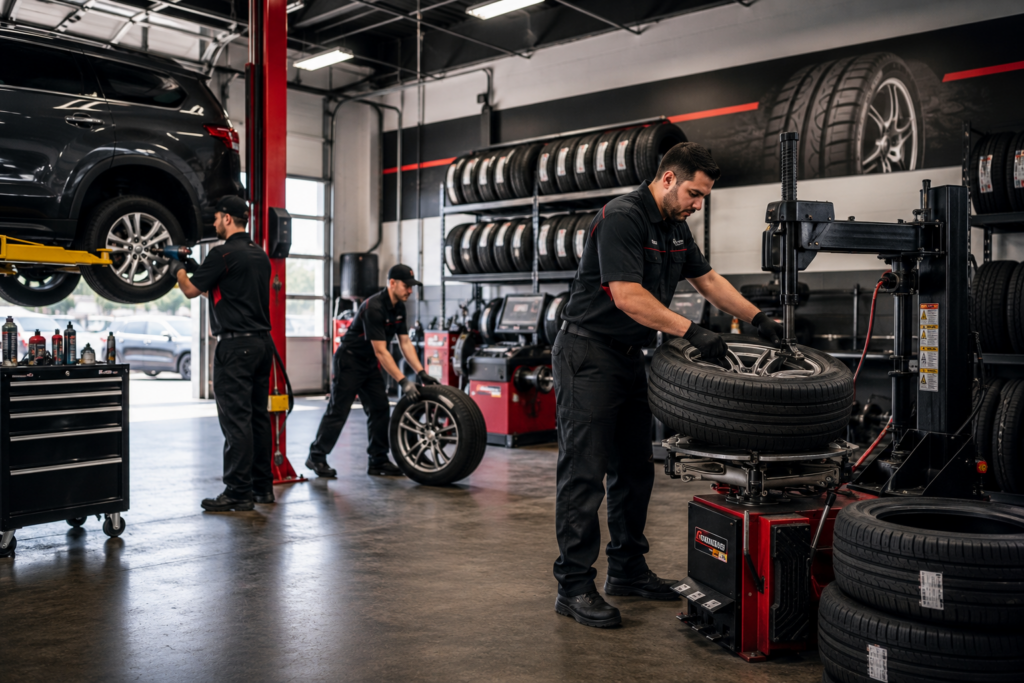
You walk in for a set of tires and walk out with exactly that: four new tires, mounted and balanced, and a receipt. Nothing wrong with that, until you notice the new tires wearing unevenly a few thousand miles later, or the steering still pulls, or the same noise you came in with never actually went away.
A tire is rarely just a tire. It is the only part of your car that touches the road, which makes it the first place that trouble elsewhere in the vehicle tends to show up. So where you buy tires is a bigger decision than the price on the sign out front.
A tire-only shop is built to do one job well: sell, mount, and balance tires. That is genuinely useful when a tire is the whole story, like a nail in the tread or a set that has simply worn out after years of honest miles.
The trouble starts when the tire is a symptom rather than the cause. Uneven wear across the tread often points to alignment or tired suspension. A vibration that builds with speed can be a balance issue, or it can be something turning in the drivetrain. A steady pull to one side might mean you need professional wheel alignment Tulsa services, or it might be related to brakes or suspension issues.
A shop that only handles tires can sell you new rubber, but it cannot diagnose or repair whatever chewed up the old set. You end up paying twice: once for the tires, and again when the real problem resurfaces somewhere down the road.
The difference is not just a longer list of services on the wall. It is the ability to treat the tire as part of the whole car. NHTSA notes that routine alignment, balance, and rotation help tires last longer, and proper inflation alone can add roughly 4,700 miles to a tire’s life. Getting that upkeep right is easier at a shop that already works on everything underneath the car.
Newer vehicles, including EVs. Electric vehicles are heavier and deliver torque the instant you press the pedal, which tends to wear tires faster and calls for the right load ratings and rotation habits. A shop that already works on the rest of the car is better positioned to get these details right than one that only stocks and mounts tires.
“Full-service” gets printed on a lot of signs, so it helps to know what actually backs it up. Before you hand over your keys, look for:
A shop that checks most of these boxes is one that can address the cause, not only the tire.
Plenty of shops fit this description, and the better ones are often local operations that have built out a full bay of services over the years rather than chains focused purely on tire volume.
For example, Same Day Auto Repair, a family-owned auto repair & tire shop Tulsa, pairs its tire selection with in-house alignments, brakes, and diagnostics, and even brings tire service to your driveway through a mobile option, which is the kind of range that separates a true full-service shop from a tire counter.
Wherever you live, the lesson is the same: choose the shop by what it can actually fix, not just by what it can sell you.
New tires are one of the best safety investments you can make, but they are only as good as the car they are bolted to. A tire-only shop can get you rolling again. A full-service shop can tell you why you ended up there in the first place and keep you from coming back for the same reason.
The next time you are due for tires, spend a minute evaluating the shop, not just the sticker price. That is the difference between buying four tires and genuinely fixing your car.



Leave a Reply