


Canada’s automotive aftermarket posted solid sales in 2025, supported by the large wave of vehicles sold from 2015 to 2019 moving into peak service years, according to a new survey by DesRosiers Automotive Consultants in partnership with the Automotive Aftermarket Retailers of Ontario.
“With the high volume of vehicles sold from 2015-2019 now in their peak aftermarket years it is not surprising that the Canadian automotive [industry] continued to see robust sales growth in 2025,” said Andrew King, Managing Partner at DAC. “However, supply issues have persisted, especially in regard to OEM parts, and the outlook for the aftermarket has a number of concerns moving forward.”
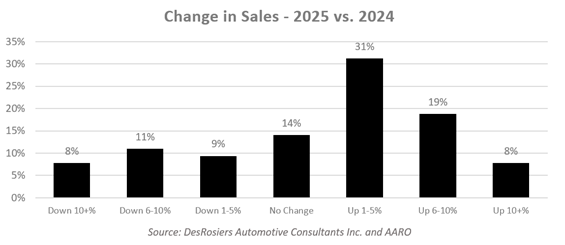
The largest share of respondents, at 31 per cent, reported 2025 sales were one to five per cent above 2024. A further 19 per cent cited gains of six to 10 per cent, and eight per cent saw increases of 10 per cent or more. A combined 28 per cent reported declines of varying sizes, while 14 per cent said sales were flat.
Looking ahead, most retailers expect modest growth in 2026. The largest group, 44 per cent, forecast an increase of one to five per cent from 2025. Another 11 per cent expect gains of six to 10 per cent, and five per cent anticipate growth of at least 10 per cent. Fifteen per cent foresee no change, while a combined 26 per cent expect declines.
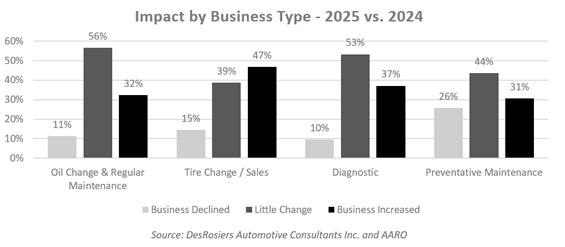
Shifts in work mix were mixed. Oil changes and regular maintenance, along with diagnostic and preventative work, were most likely to hold steady. Tire changes and tire sales were more likely to grow, with 47 per cent pointing to increases in 2025. Declines were the least common outcome across the four categories, though preventative maintenance stood out, with 26 per cent reporting drops, higher than the other areas.
Parts flow remained a pressure point, especially from dealers. Two thirds of respondents, 66 per cent, reported no supply issues from jobbers, while 34 per cent did. The pattern reversed for new vehicle dealers. Sixty eight per cent cited dealer-related supply issues and 32 per cent did not. DAC noted that in last year’s survey, jobber supply problems were more common and dealer issues slightly less so.
Prices rose broadly. No respondents reported parts price decreases from either jobbers or dealers. From jobbers, 39 per cent saw increases of up to five per cent, 40 per cent reported six to 10 per cent, and 19 per cent saw price hikes of 10 per cent or more. From new vehicle dealers, 39 per cent pointed to increases of up to five per cent, 23 per cent saw six to 10 per cent, and 34 per cent reported jumps of 10 per cent or more.
DAC said the survey is one input into its broader aftermarket tracking and analysis for 2025 and its view of 2026 conditions. The firm pointed to ongoing parts availability and pricing as key watch items, even as shops prepare for another year of demand from a growing pool of older vehicles.
Image credit: Depositphotos.com







Leave a Reply