


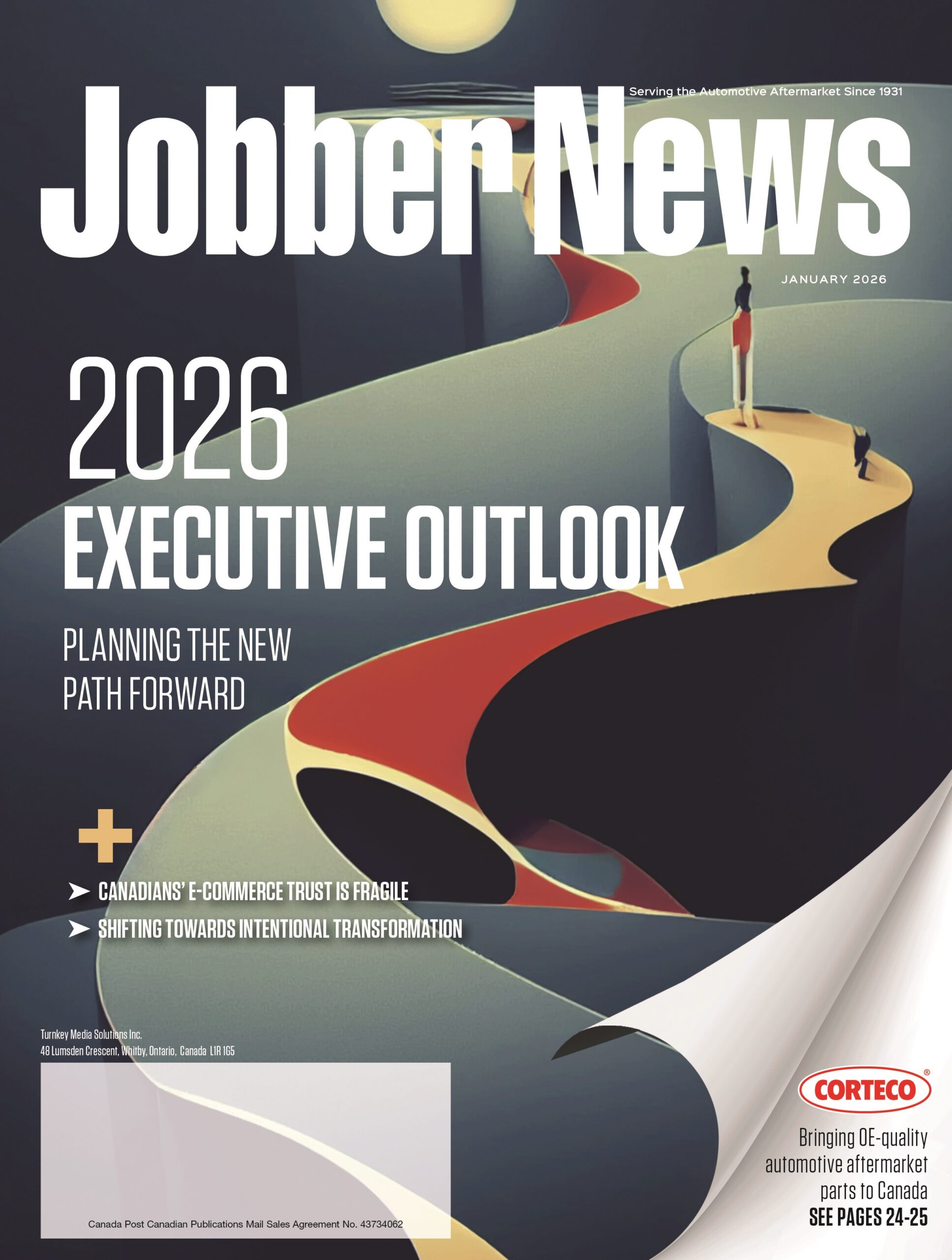
It’s the annual Executive Outlook feature in Jobber News, where we hear from 10 distribution leaders about what they see taking place in our industry today.
We asked them three questions about the next 12 months:
- How can the industry leverage technology (AI, predictive analytics, demand forecasting) to improve business (optimize inventory levels, distribution efficiency)?
- What are some lasting impacts or lessons that the industry has learned from the last year?
- Where will jobbers, distributors, and/or suppliers find success in 2026?
Check out what they had to say. You can read the intro to the feature below.
Flip through the issue and you’ll find expert insight, like Kumar Saha’s thoughts on the challenges facing distributors when it comes to e-commerce. He offers five strategies to put in place to win over the trust of customers.
Zakari Krieger explores the next chapter for aftermarket distribution, focusing on profitability and AI adoption.
There’s always more, like our Letters, News and By the Numbers sections. So grab your copy or flip through the digital edition.
2026 Aftermarket Distribution Executive Outlook
In the year ahead, leaders look to turn to AI, raise concerns about consumer caution, uncertainty, test to supply chains, diversifying and more to find success and navigate challenges

The automotive aftermarket heads into 2026 with tight margins, cautious consumers and a sharper focus on execution. Leaders across the supplier, distributor and manufacturer segments point to data-driven operations as the path to better results.
Artificial intelligence, predictive analytics and demand forecasting are being applied to trim overstock, protect fill rates, lower carrying costs and speed delivery from shelf to hoist. Inventory discipline replaces just-in-case buying, while controlled distribution and private‑label strategies emerge as steady tools to protect profitability.
But consumer behaviour is being closely watched. So far, it can be described as a measured response, leaders said. Shops are seeing customers shy away from service and repairs unless it’s needed now. Product selection is splitting toward premium parts at one end and opening‑price options at the other, with the middle thinning. That puts pressure on assortments and on having the right SKUs in the right markets. Availability, speed and reliability are the deciding factors.
Nathan Shipley, executive director and industry analyst in Circana’s automotive aftermarket practice, pointed to what he called the underlying health of the sector, supported by how much and how often people still drive, an aging vehicle fleet and long-term changes in work patterns.
“The fundamentals of the industry are pretty healthy,” he said at AAPEX 2025 in Las Vegas.
With more people returning to work at an office — in Ontario, public service workers have been mandated to be at the office five days a week, while many of Canada’s big banks have called employees to the office at least four days a week — the age of the commute is set to return, resulting in increased vehicle usage or, at least, different usage of vehicles compared to the last several years.
Low-income households are more likely to delay work that can be put off, such as new tires or wiper blades, to manage monthly budgets, Shipley pointed out. By contrast, higher income drivers are looking for savings in other ways, including doing more work themselves.
There is a clear rise in do-it-yourself behaviour across several consumer categories — think upgrades around the house — and the automotive aftermarket is no exception, Shipley observed.
“So there’s a definite trend of shifting to DIY, and we’re observing it in the automotive aftermarket,” he said.
Policy and supply chains are adding uncertainty. Tariff talk and shifting rules have reintroduced volatility after a brief period of calm. The consensus response is to diversify supply, reinforce vendor relationships and remain agile. Consolidation continues on the supplier side and among distributors. Scale can help with systems and service, but concentration also magnifies risk when a key partner falters. Organizations that invested in governance, people and data are pulling away from the competition.
Heading into 2026, Jobber News called upon 10 industry leaders across the distribution segment to give their insights into what lies ahead for suppliers, jobbers and distributors. They were asked three questions:How can the industry leverage technology (AI, predictive analytics, demand forecasting) to improve business (optimize inventory levels, distribution efficiency)? What are some lasting impacts or lessons that the industry has learned from the last year? Where will jobbers, distributors, and/or suppliers find success in 2026?
We’ll share their responses online over the next several weeks.





Leave a Reply