

How Auto Shops Can Source Low-Volume Custom Metal Parts Faster
Share

View the latest digital editions of all of our publications or head straight to the archives

Share
For many repair businesses, this is where low-volume sourcing becomes important. Instead of waiting for a factory backorder, chasing a used component of uncertain quality, or trying to modify an off-the-shelf part that does not fit correctly, shops can often move faster by sourcing low-volume custom metal parts built for the specific job.
This does not mean every repair shop needs to become a manufacturer. It simply means understanding when custom metal parts make sense, what information suppliers need, and how to avoid the common mistakes that slow the process down. When handled correctly, low-volume custom sourcing can reduce downtime, improve repair quality, and help shops solve unusual jobs more efficiently.
For many repair businesses, this is where low-volume sourcing becomes important. Instead of waiting for a factory backorder, chasing a used component of uncertain quality, or trying to modify an off-the-shelf part that does not fit correctly, shops can often move faster by sourcing low volume custom metal parts built for the specific job.
This does not mean every repair shop needs to become a manufacturer. It simply means understanding when custom metal parts make sense, what information suppliers need, and how to avoid the common mistakes that slow the process down. When handled correctly, low-volume custom sourcing can reduce downtime, improve repair quality, and help shops solve unusual jobs more efficiently.
The aftermarket is no longer dealing with a simple, one-size-fits-all parts environment. Modern vehicles include more variation across trims, sensors, body configurations, mounting points, and electronic systems. At the same time, older vehicles remain on the road longer, which means repair shops are often working on models where OEM supply is inconsistent or discontinued.
That creates a gap between what a shop needs and what the traditional supply chain can deliver quickly.
Low-volume sourcing helps fill that gap. If a repair depends on a non-standard bracket, a broken aluminum cover, a custom mounting plate, or a replacement fixture for shop equipment, ordering one or a few purpose-built pieces can be much faster than waiting for a hard-to-find original part. It can also be more reliable than improvising with a universal part that only “almost fits.”
For shops that handle specialty work, fleet service, restoration, performance upgrades, calibration-related mounting needs, or equipment maintenance, this flexibility can become a real operational advantage.
Not every part should be custom made. If a standard service part is available at a reasonable cost and lead time, buying the standard part is usually the better option.
However, custom sourcing becomes very practical when the required part is:
Common examples include:
These parts often do not justify expensive tooling or mass production. But they do fit well into a low-volume manufacturing model, where one, five, ten, or fifty pieces can be produced quickly for a specific need.
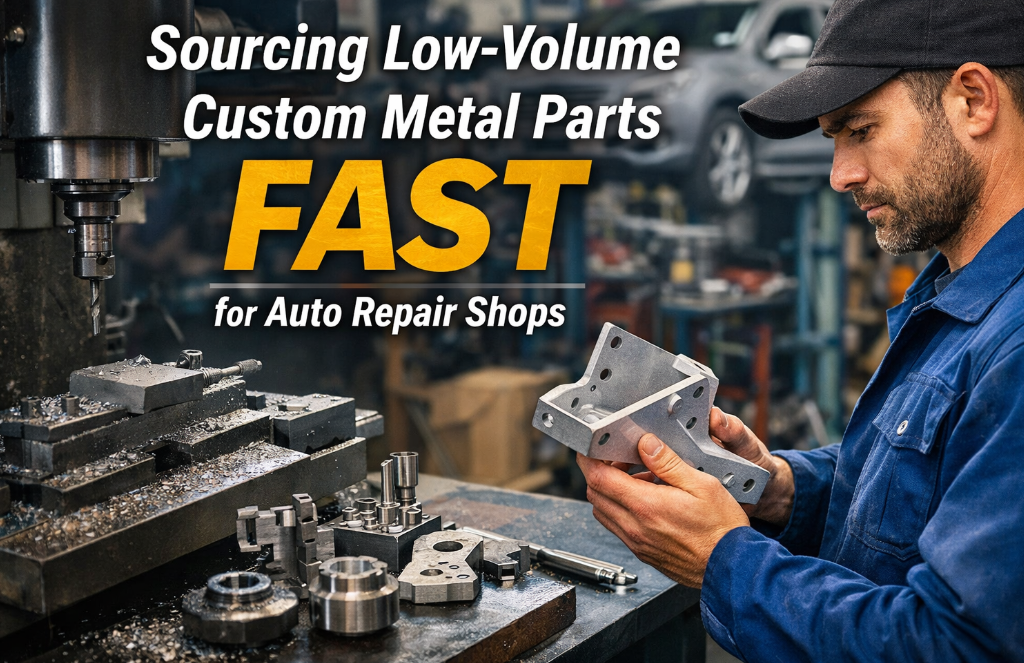
One reason custom part orders get delayed is that the request starts too vaguely. A supplier can only move quickly if the shop provides clear information at the beginning.
The fastest path usually starts with these basics:
If the broken or missing part is available, clear photos from multiple angles are extremely helpful. If the original part still exists, even in damaged condition, sending a physical sample can save time and reduce guesswork.
At minimum, the supplier should know the critical dimensions: length, width, thickness, hole locations, bend angles, and any features that affect fit. If a full CAD file is available, that is ideal. But in many repair scenarios, a marked-up sketch with accurate dimensions can still be enough to start.
Not every part needs the same material. A cosmetic cover, a structural bracket, and a heat-exposed mounting component all have different needs. Aluminum is often a strong option for lightweight, corrosion-resistant parts. Steel may be better for higher strength or lower material cost. The right choice depends on function, not guesswork.
Shops should also think about whether the part needs bare metal, powder coating, anodizing, plating, or some other finish. In many cases, a simple protective finish is enough. But if the part will be visible, exposed to weather, or installed near corrosive conditions, finishing matters.
The production method often changes depending on whether the shop needs 1 piece, 5 pieces, or 50 pieces. Stating quantity early helps the supplier choose the most efficient process, whether that is machining, sheet metal fabrication, or another route.
When these details are ready up front, the supplier can quote faster and recommend the right production method with fewer revisions.
One of the biggest misconceptions in custom part sourcing is assuming there is only one way to make a part. In reality, a simple design change can often move a part from a slower, more expensive process to a faster and more economical one.
For example:
This matters because repair shops are not just buying a part. They are buying lead time and functionality.
If a supplier reviews the part and says, “This can be redesigned slightly and produced faster by sheet metal instead of machining,” that is not a sales trick. In many cases, it is the most practical way to reduce cost and shorten turnaround.
That is why working with a supplier that understands both manufacturability and real-world use cases is so valuable.
Many shops only think about custom sourcing when a repair is already stuck. That is understandable, but it is not always the best strategy.
A better approach is to identify recurring pain points and solve them in advance.
For example, if your shop repeatedly sees the same broken mounting tab, discontinued support bracket, or hard-to-source equipment component, it may make sense to order a small batch instead of waiting until the next breakdown. Even a batch of five or ten can dramatically reduce future downtime.
In these cases, custom sourcing becomes less of an emergency expense and more of an inventory and workflow advantage.
Some shop owners hear “custom” and immediately assume long delays, high setup costs, and engineering complexity. That can be true for some projects, but not for all.
Simple custom metal components are often much more manageable than people expect, especially when the geometry is straightforward, or the quantity is low
In fact, the right supplier can often streamline the process by reviewing the design, suggesting small changes, and recommending a faster production route. This is one reason many repair businesses now use custom replacement parts not as a last resort, but as a practical option when standard sourcing slows the job down.
The real question is not “Is it custom?”
The real question is “Will this solve the problem faster and more reliably than waiting?”
To get the best results, repair shops should treat custom sourcing like a process, not a desperate workaround.
Here are a few best practices that save time and reduce headaches:
Tell the supplier which features truly matter. Does the hole pattern need tight positional accuracy? Is the bend angle critical? Is the part mainly a cover where appearance matters more than precision? Not every dimension needs the same level of control.
If the supplier suggests machining, cutting and bending, or another process, ask why. The explanation can help you understand where cost and time come from, and whether there is room to simplify.
If the application is unusual, it may be wise to test one or two pieces before ordering a larger batch. That approach can prevent costly rework later.
If the same issue is likely to happen again, consider ordering a small backup quantity. The unit cost may improve, and the next repair becomes much easier.
A good supplier should not just make the part. They should also help evaluate whether the design is reasonable, the process is efficient, and the part is appropriate for the application.
The fastest repair shops are not always the ones with the biggest inventory. Often, they are the ones that know how to solve uncommon problems without waiting on the traditional parts chain to catch up.
Low-volume custom sourcing is one of those tools. It does not replace OEM parts, and it does not make sense for every repair. But when a standard part is unavailable, delayed, or simply not the right fit, a small batch of custom metal parts can keep work moving, reduce downtime, and help the shop maintain control of the job.
In a business where stalled repairs quickly become lost time and lost revenue, that flexibility matters.
For repair shops that want to move faster, the goal is not to custom-make everything. The goal is to know when custom sourcing is the smartest path, prepare the right information, and work with suppliers who can turn a practical request into a usable part without unnecessary delay.
That is how low-volume custom sourcing stops being a bottleneck solution and starts becoming a competitive advantage.
Leave a Reply