


Shop leaders give their outlook in CARS
Share

View the latest digital editions of all of our publications or head straight to the archives

Share
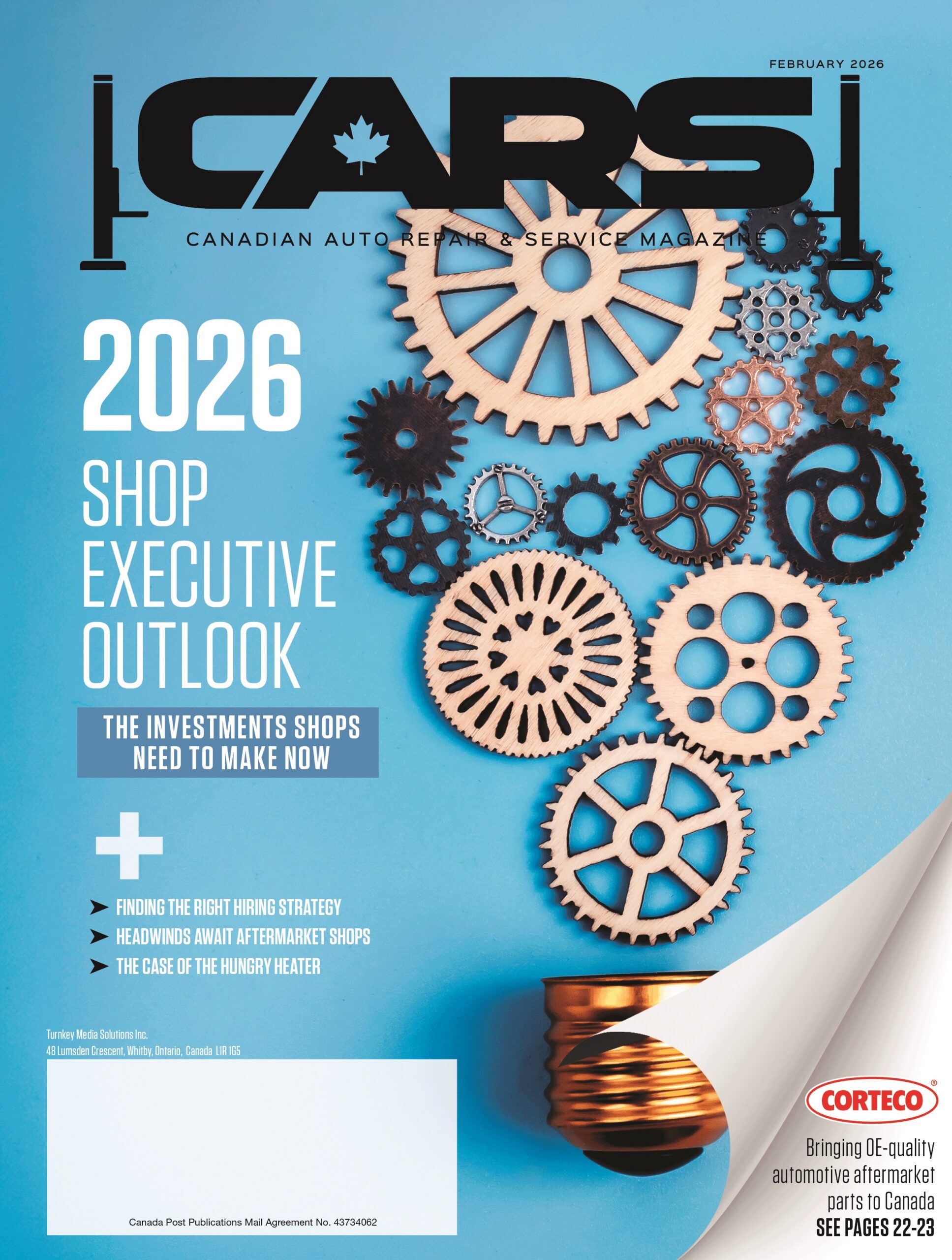
The latest issue of CARS explores the year ahead and what industry leaders see as key issues and themes going forward.
Nine leaders from the mechanical repair sector answered the following three questions:
You can find their answers by flipping through the issue. The intro to the section summing up key thoughts and ideas is below.
But that’s not everything. You can read a snippet of our interview with Barbara Moran-Goodrich, head of the Moran Family of Brands and the new owner of Mister Transmission in Canada. Learn about her business philosophy, the message to franchisees in Canada and where she sees the company going. Then listen to our podcast episode to hear the full discussion.
We have insight from Erin Vaughan on why hiring, training and growing your team doesn’t need to be an enormous endeavour. You just need the right strategy. She helps with some advice.
Greg Aguilera asks: Can you be coached? Shop owners are a resilient bunch. But it’s difficult to be asked the questions that have been ignored in your business for a long time. He explains why letting go can help lead your business to greater heights.
It’s all that and more, so grab your print issue or flip through the digital edition.
The service side of the aftermarket enters 2026 in the middle of a structural shift.
Shop leaders point to growing vehicle complexity, persistent time pressure on advisors and technicians and the rising cost of tools and training as the forces reshaping day-to-day operations. The path forward centres on workflow discipline, integrated digital systems and targeted investments that allow people to focus on diagnosis, judgment and customer care while technology handles intake, scheduling, documentation and follow-up.
The goal: To give time back to the front counter and the bays, improve productivity and protect profit.
CARS magazine spoke to nine industry leaders to provide their outlook for the year ahead. Skills development is a common thread. Continuous education is viewed as essential as shops prepare for ADAS, electric vehicles and software-driven platforms. Leaders emphasize that the constraint in many facilities is not interest in the trade, but how work is structured and how long it takes to complete high-quality diagnostics and repairs.
Survey results from this magazine show what’s at issue: Service advisors saying they are too busy and technicians saying they are not given enough time. Still, more than half report they enjoy the work, with nearly one-third saying they love it, pointing to a retention opportunity if time and process issues are addressed.
Customer experience is moving online as shops reduce reliance on constant phone calls through digital booking and communication. In the bays, priorities include ADAS-capable and EV-ready equipment, clean and safe workspaces, and layouts that support faster flow. Some leaders also flag the need to prepare for market shifts tied to tariffs or an influx of Chinese brands such as BYD, and to keep fee structures current with the skills and tooling required to service modern vehicles. Many see value in networks and associations for shared training, group purchasing and advocacy.
Talent remains a pressure point, but the focus is widening from recruitment to retention. Shops are building clearer career paths, including diagnostic roles and technologist tracks, adding mentorship and apprenticeship links to schools and offering employer-funded training during work hours. Culture and structure matter to younger workers, who look for organized shops, modern tools and visible advancement.
Right to repair is on the agenda as leaders call for unrestricted access to calibration, software and repair information to maintain consumer choice and support competition. Many also point to the value of standard operating procedures and AI-enabled tools that help build and refine workflows.
The outlook is pragmatic. Shops that align training with the work they plan to perform, price diagnostics transparently, modernize customer touchpoints and equipment, and use data to remove delays are best positioned to grow. The theme is consistent across voices, run the business with intention, protect technician time, and build the systems that let people do their best work.
We asked the leaders three questions: How are or how should shop leaders be preparing their facilities to service the complex systems in vehicles today effectively and profitably? What innovative strategies do you want to see to not only attract new talent into the trade but also to improve retention rates, especially considering the high cost of training and tooling? What is one challenge and one opportunity that shops will face in 2026?
We will share their answers over the coming weeks.

Thank you Bruce for enjoying my article I wrote last December. I thought it was very good as well. I’m glad I was able to take you back to your early days of business. I’m very thankful for Adam Malik allowing me to voice my opinion showing an alternative business method from the Greenwood shop method that seems to have a strong following across North America. The automotive repair business is made up of many shapes and sizes, from DIY’ers, to technicians operating illegal cash businesses in residential areas with industrial equipment after hours and on weekends, to low overhead shops like mine employing 1-5 people, to larger overhead multi-bay shops like yours employing many people, to multi building businesses, to franchises, and to dealerships. The question is which operation; the Greenwood shop or the Nurse shop has a better profit to risk/burden ratio for the aftermarket sector. I can only think of two ways to solve this question. #1 we compare finances and see which is better. or #2 we have Adam visit both our shops during the busy tire season unexpectedly, without us knowing and watch our daily activity for a day. Then he can wright an article about the good, the bad and the ugly between both business styles. I have thick skin I can take Adam’s criticism. No matter what he writes, I will not change my ways, and its obvious it wont change yours, but it might persuade some readers either way. Finally Bob Greenwood told me in 2005 over beers and wings after a course, that if I did not have 20 bays and at least 10 technicians by 2020 I would not be able to afford to stay in business. Bob was wrong!
Every Technician owner comes to a cross road to remove themselves from the bays or not. Whether staying in this industry or not. When I reached that cross road and took over my parents business I chose to persevere and remain in the bays with my fellow technician / brother-in-law. What was I suppose to do? Tell him to run the back end and I will take care of the front end. He would of quit and I would of had to deal with a revolving door of incompetency. Instead I showed him I had his back and I stayed in the trenches with him. After forty-five years of working together, we make a four bay shop sing. We are not the smartest or fastest technicians out there but we get bye and what we produce out of that small shop with MINIMAL mistakes is no less than amazing. We know each others work patterns so well it just works. I’m not in business to provide a livelihood for as many people as possible, I’m not in business to support the community or provide funding to as many charities as possible, with the expectation to draw in more business and make more money. I’m not a greedy businessman! My main role as a business owner is to make enough honest money without ripping off or gouging the consumer, to allow my brother-in-law and myself to get out of this industry financially comfortable. For the most part I love operating a shop like mine and am proud of everything we have accomplished. Bob Greenwood told me in 2025 over beers and wings after a course, that if I did not have 20 bays and at least 10 technicians by 2020 I would be out of business. Bob was wrong!
Sorry Bob Greenwood told me in 2005 not 2025





Leave a Reply